
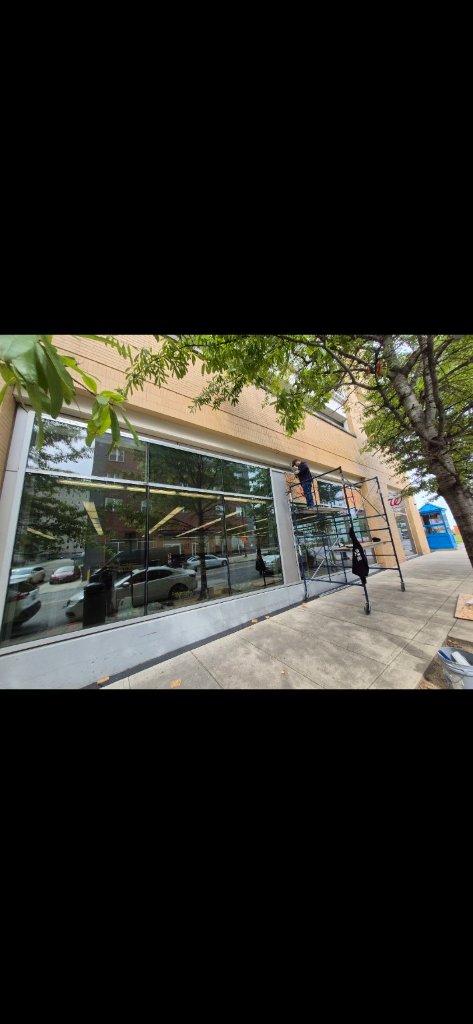
Field water testing is the only place where the installed assembly, the actual sealant work and the real building geometry meet. Done properly, it finds the leak before the tenant does.
Done lazily, it produces a passing report that means nothing, because the test pressure was set below the wind-driven rain the facade will actually see.
What the standards actually test
The two field tests that matter on a commercial facade are different tools:
ASTM E1105 applies a uniform static air pressure difference across the assembly while water is sprayed on the exterior face. It measures water penetration under a controlled pressure.
AAMA 501.2 is the field hose test, used to check sealant joints, corners and interfaces at a defined nozzle pressure and distance. It is a joint test, not a performance rating.
AAMA 501.1 is the laboratory dynamic test, where pressure is applied with a moving air stream and water. It is the closest laboratory analogue to wind-driven rain.
Why 15 psf is a starting point, not an answer
15 psf shows up in specifications because it is a common minimum, not because it represents a high-rise facade. Wind pressure on a tall building rises with height and exposure, and the design pressure for the assembly is calculated for the project.
Field test pressure should be derived from that design pressure, with the specification stating the percentage to be applied in the field. A 15 psf test on a facade designed for 45 psf demonstrates very little about how the assembly behaves in a storm.
Where leaks actually start
On the facades we test, water almost never enters through the glass. It enters at the transitions:
Head and sill conditions where the curtain wall meets structure or another material.
Corner joints and shear blocks where sealant adhesion failed or was never applied.
Gasket compression at panel interlocks, especially where frames were racked during installation.
Expansion joints and terminations that were designed to drain but were sealed solid in the field.
What to require in a specification
Require field water testing on representative areas at a pressure derived from the project design pressure, with the test method, pressure, duration and acceptance criteria stated explicitly. Require the report to identify each tested area by elevation and grid, not just a pass or fail summary.
Then require that any failed area be corrected and retested before closeout. A test that is not tied to a retest obligation is a formality.
Frequently Asked Questions
Is field water testing required by code?
It is more often a specification requirement than a code requirement, though some jurisdictions and project types require it. Where it is specified, the method and pressure should be defined rather than left to the contractor.
How many areas need to be tested?
The specification usually sets a percentage of representative areas, plus every typical condition such as a corner, a head, a sill and an expansion joint. Testing only the easiest flat run proves the least.
What happens if a test fails?
The failed area is documented, the source of the leak is located, the condition is corrected and the area is retested. A failure that is quietly patched and not retested leaves an unknown condition in the envelope.