
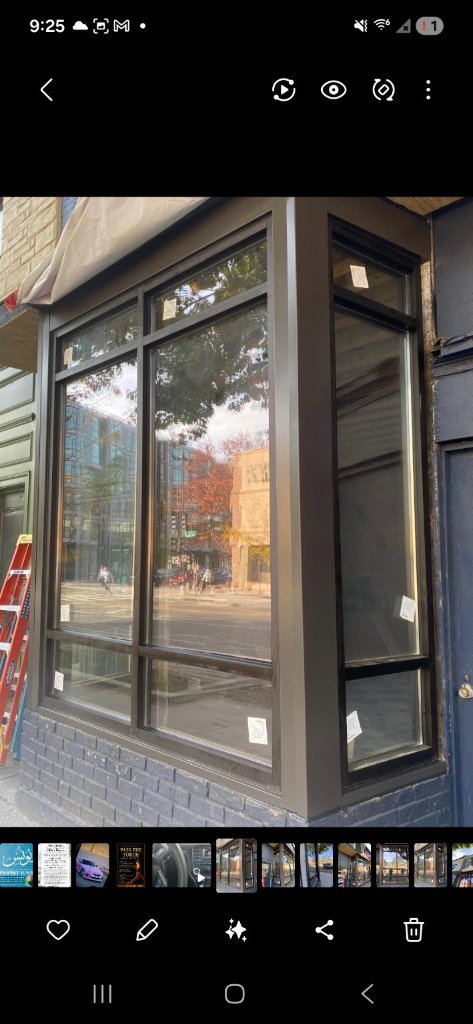
Every commercial glazing permit in Washington DC eventually meets the same question: does this assembly meet the energy code? The answer is rarely a single number from a glass sample, because the code is applied to the fenestration assembly, not to the pane.
This is a practical guide to what DC reviewers look for on storefront and curtain wall submittals, and the three places projects most often fail.
Assembly performance, not center-of-glass
The U-factor that matters is the assembly value: glass, spacer, frame and thermal break together. A high-performance insulating unit in a non-thermally-broken aluminum frame still produces a poor assembly U-factor, because the frame is the thermal bridge.
Manufacturers publish assembly U-factors per NFRC 100 for specific combinations of frame and glazing. When a submittal shows only a center-of-glass value, the review has nothing to check against the code table.
The three numbers reviewers check
Commercial envelope review in the DC market generally comes down to these, with the edition enforced by the Department of Buildings confirmed on every permit:
U-factor for vertical fenestration, compared against the prescriptive table or the COMcheck trade-off model.
Solar heat gain coefficient (SHGC), which drives cooling load far more than U-factor on east and west exposures.
Visible light transmittance, because low SHGC achieved by darkening the glass has a lighting cost the energy model has to account for.
Where storefront projects get rejected
Three failure patterns account for most of the resubmittals we see:
A non-thermal storefront specified in a conditioned envelope, because it was carried over from an interior detail.
A glass make-up changed during value engineering without updating the NFRC documentation, so the submitted U-factor no longer matches the product.
A trade-off model built on the wrong baseline, which passes on paper and fails on inspection when the installed assembly does not match the model.
What we submit with a glazing permit
For each project we provide the manufacturer product data with NFRC assembly values for the exact frame and glazing combination, a glazing schedule by elevation, and the energy compliance documentation the jurisdiction requires. If the scope changes, the documentation is revised before the glass is ordered.
That is the difference between a permit that clears review and one that cycles twice while the schedule burns.
Frequently Asked Questions
Can I keep my existing storefront frames and just upgrade the glass?
Sometimes. The assembly U-factor is limited by the frame, so a glass-only upgrade may not reach the code threshold. We model the existing frame with the proposed glass before recommending it.
Is a thermally broken storefront required on every commercial project in DC?
It depends on the scope and how the envelope is modeled. New and altered conditioned envelopes generally need to meet the code performance path, which non-thermal aluminum rarely achieves. The authority having jurisdiction has the final word.
What is the difference between U-factor and R-value?
They are inverses. U-factor measures heat flow through the assembly; R-value measures resistance. Codes for fenestration are written in U-factor, so that is the number to collect from the manufacturer.